Free early access
Turn this guide into an organised landlord workflow
Landlord Wise is free during early access. Register, choose your property state, and keep rent, documents, maintenance, deadlines and evidence organised.
Guide scope
This guide is a practical starting point for Australian landlords. Tenancy rules, authority processes and forms can change by state or territory, so use it to understand the workflow, then check the current authority process before issuing formal notices, lodging tribunal applications or making legal or financial decisions. Landlord Wise can help you organise records and ask Wise AI state-specific questions.
Looking for the full resource hub?
Use the Self-Managing Landlord Guide to browse Landlord Wise articles and tools by workflow: setup, tenants, rent, inspections, bonds, tax and state legislation.
You can manage your own rental property in Australia. There is no general rule that says a landlord must use a property manager for a residential rental. The important point is that the same tenancy laws still apply to you, whether you manage the property yourself or appoint an agent.
Self-managing can save thousands of dollars per year in property management fees, but it also means you are responsible for the work: tenant records, lease paperwork, condition reports, bond evidence, rent records, repairs, maintenance, notices, and tax records.
This guide is the broad starting point. It explains how to self-manage a rental property step by step, then points you to state-specific guides for WA, NSW, QLD, VIC and SA because rental rules differ across Australia.
If you are already comparing the financial side, use the property management savings calculator to estimate how much a property manager may cost for your rent and fee structure.
Can I Manage My Own Rental Property?
Yes. If you own the property, you can usually manage it yourself without holding a real estate licence. Licensing rules are aimed at people managing property for someone else for reward, not an owner managing their own rental.
The trade-off is responsibility. A property manager usually handles leasing, bond administration, inspections, repairs, rent follow-up, notices, tenant communication and routine paperwork. When you self-manage, those tasks move to you.
That does not mean self-management is only for experts. It means you need a clear system and you need to know which parts of the process are governed by state law. The national pattern is similar across Australia, but the actual forms, deadlines and authorities are state-specific.
How to Self-Manage a Rental Property Step by Step
Start with a simple workflow:
- Check the rules for your state or territory.
- Set up a clean record system for the property, tenant, lease, rent, expenses and documents.
- Use the correct tenancy agreement for your state.
- Complete the condition report before or at the start of the tenancy.
- Collect and lodge the bond with the correct state authority.
- Keep rent records, receipts where required, arrears notes and payment evidence.
- Respond to repairs and maintenance requests promptly.
- Use the correct process for inspections, rent increases and notices.
- Store every important document and communication trail.
- Prepare clean EOFY records for your accountant or tax return.
This page gives the overview. The detailed legal work should live in the state-specific guides, not in a single national article that tries to cover every deadline in every jurisdiction.
Rental Property Management Checklist
Use this checklist before, during and after a tenancy.
Before Advertising
- Confirm the property is safe, clean and ready to rent.
- Check smoke alarm, pool, electrical, water, minimum housing and safety obligations for your state.
- Decide whether you will advertise yourself or use an agent/listing service for tenant sourcing.
- Set a market rent using comparable properties.
- Confirm landlord insurance and building insurance.
- Set up a dedicated bank account or clean rent-tracking process.
- Create a property document folder for insurance, rates, water, strata, repairs and compliance records.
Find and Screen Tenants Carefully
Tenant selection is one of the highest-risk parts of self-management. Before approving an applicant, check their identity, income, employment, rental history, references and whether the rent appears affordable for their circumstances.
Keep the process consistent for every applicant. Use clear selection criteria, keep notes, follow privacy requirements, and avoid decisions based on protected personal attributes rather than the applicant’s ability to meet the tenancy obligations.
Before the Tenant Moves In
Before a tenant moves in, the same broad workflow applies across Australia: use the correct agreement, record tenant and notice details, collect only the permitted bond, lodge it with the right authority, complete the written condition report or inspection sheet, give the required state information documents, and store the evidence.
The details change by state:
| State | Agreement and starting documents | Bond and condition evidence |
|---|---|---|
| WA | Form 1AA tenancy agreement, tenant information and WA-specific notices. | Bond Administrator; Form 1 property condition report with photos as supporting evidence. |
| NSW | Standard residential tenancy agreement, Tenant Information Statement and prescribed condition report. | NSW Fair Trading / Rental Bonds Online; condition report before or when the agreement is signed. |
| QLD | General Tenancy Agreement Form 18a and RTA starting documents. | Residential Tenancies Authority; entry condition report and supporting photos. |
| VIC | Form 1 residential rental agreement for most agreements of 5 years or less, plus Renters Guide evidence. | RTBA; Form 4 condition report before the renter moves in. |
| SA | Fixed-term or periodic lease agreement, Section 48 notice and Tenant Information Guide. | Consumer and Business Services; inspection sheet and supporting evidence. |
| TAS | Written agreement strongly recommended, plus CBOS rental guidance. | Rental Deposit Authority / MyBond; condition report required if a bond is taken. |
| ACT | Agreement must include the Standard Residential Tenancy Terms, with the Renting Book provided. | Office of Rental Bonds; condition report shortly after possession starts. |
Use the relevant lease and bond guides before signing:
- WA lease agreement guide and WA rental bond guide
- NSW lease agreement guide and NSW rental bond guide
- QLD lease agreement guide and QLD rental bond guide
- VIC lease agreement guide and VIC rental bond guide
- SA lease agreement guide and SA rental bond guide
- TAS lease agreement guide and TAS rental bond guide
- ACT tenancy agreement guide and ACT rental bond guide
During the Tenancy
- Track rent due dates, rent received and any arrears.
- Keep maintenance requests, quotes, invoices and tenant messages together.
- Give proper notice before inspections or entry.
- Document inspection outcomes and follow-up repairs.
- Review rent only when your state rules allow it.
- Keep every notice, email, SMS and supporting document.
- Avoid informal shortcuts for legal notices or bond deductions.
When Something Goes Wrong
If rent falls behind, repairs become urgent, a notice is disputed, or a tenancy may need to end, check the state-specific process before acting. Use the correct form or written notice, calculate dates carefully, keep the rent ledger and evidence, and do not change locks, remove belongings or pressure a tenant outside the lawful process.
| State | Main dispute body | Notice and escalation examples |
|---|---|---|
| WA | Magistrates Court of WA | WA uses prescribed forms for many notices, including rent increase, entry, breach and termination forms. |
| NSW | NCAT | NSW uses prescribed termination notices, Rental Bonds Online processes and NCAT for disputes, repairs, rent and termination orders. |
| QLD | QCAT | QLD uses RTA forms such as Notice to Remedy Breach, Entry Notice and Notice to Leave, with QCAT for unresolved disputes. |
| VIC | VCAT | VIC rental providers use prescribed entry, rent increase and notice-to-vacate processes; VCAT handles unresolved disputes. |
| SA | SACAT | SA uses forms such as Form 5 for breach and termination, with SACAT for possession and tenancy disputes. |
| TAS | Magistrates Court / Residential Tenancy Commissioner | TAS uses Notice to Vacate grounds and strict timing, with bond and possession pathways through state bodies. |
| ACT | ACAT | ACT uses Standard Terms, ACAT review pathways and specific rules for rent increases, possession and disputes. |
Useful next guides:
- WA rent increase guide and WA eviction notice guide
- NSW rent increase guide and NSW eviction notice guide
- QLD rent increase guide and QLD eviction notice guide
- VIC rent increase guide and VIC notice to vacate guide
- SA rent increase guide and SA eviction notice guide
- TAS rent increase guide and TAS eviction notice guide
- ACT rent increase guide and ACT eviction notice guide
At EOFY
- Reconcile rent received for the financial year.
- Categorise expenses by property.
- Keep invoices and receipts for repairs, insurance, rates, strata, water and other rental costs.
- Keep loan interest statements separate from principal repayments.
- Review depreciation records separately with your accountant where relevant.
- Keep records for the required retention period.
Landlord Wise includes rent records, expense records, EOFY statement generation and a separate depreciation section for Division 40 and Division 43 tracking. Depreciation schedules are separate from the EOFY statement and should be reviewed with an accountant before deciding what to claim. You can also use the public depreciation calculator for estimates.
Do I Need a Property Manager?
You may not need a property manager if you want direct visibility over your tenant and property, and you are comfortable using a structured system for records, rent, inspections, maintenance and notices.
A property manager may still make sense if you want someone else to handle local attendance, routine inspections, formal notices, tribunal preparation or difficult tenant conversations on your behalf.
This is also where Wise AI can reduce the day-to-day uncertainty. In Landlord Wise, you can ask Wise AI about Australian tenancy rules, notices, rent increases, bonds, condition reports, repairs and record-keeping, then keep the answer alongside the property records you are working from. It is useful for checking the next step before you act, while formal disputes, tribunal matters and unclear legal situations should still be checked against the official authority or professional advice.
| Decision point | Self-management may suit you if… | A property manager may help if… |
|---|---|---|
| Visibility | You want direct access to tenant, rent, repair and document history. | You prefer an agent to filter communication and present summaries. |
| Compliance | You are willing to follow state-specific checklists, ask Wise AI for rule checks, and keep evidence. | You want someone else to prepare routine notices and manage deadline tracking. |
| Local work | You can attend locally or have reliable trades and inspection support. | You need someone else to attend inspections, access appointments or urgent site issues. |
| Disputes | You are comfortable preparing evidence, using Wise AI to organise the issue, and seeking advice when a formal dispute arises. | You want representation or support for tribunal preparation and difficult conversations. |
For deeper comparisons, see Self-Managing vs Property Manager WA, Property Management Fees Perth and Property Management Fees Adelaide. You can also estimate the cost difference with the property management savings calculator.
Set Up the Lease and Tenant Records
The lease is the foundation of the tenancy. Each state has its own requirements:
- WA uses the prescribed Form 1AA for written residential tenancy agreements.
- NSW uses the standard residential tenancy agreement prescribed by NSW regulations.
- QLD uses the General Tenancy Agreement, Form 18a.
- VIC generally uses the prescribed Form 1 residential rental agreement for written agreements of 5 years or less.
- SA has CBS fixed-term and periodic lease agreement forms, with required starting documents such as the Section 48 notice and Tenant Information Guide.
Do not use a generic lease template without checking whether it is valid in your state. The safest approach is to start with the relevant state lease guide:
- WA lease agreement guide
- NSW lease agreement guide
- QLD lease agreement guide
- VIC lease agreement guide
- SA lease agreement guide
Landlord Wise lets Australian landlords register free, set up properties, create or upload lease agreements, and manage tenancy documents in one place.
Complete Condition Reports and Store Evidence
The condition report is one of the most important self-management documents. It records the property’s condition at the start of the tenancy and becomes key evidence if there is a bond dispute later.
Treat the condition report as a written form-based record first. Photos and videos are useful supporting evidence, but they do not replace the written condition report.
Detailed guides:
- WA property condition report guide
- NSW condition report guide
- QLD condition report guide
- VIC condition report guide
Landlord Wise supports condition report drafting, AI photo descriptions, document storage, and state-aware tenancy workflows for Australian landlords.
Handle Bond Records
Bond rules are state-specific, but the practical record-keeping pattern is similar:
- collect no more than the legal maximum;
- lodge the bond with the correct state authority;
- keep the lodgement receipt or reference;
- keep condition reports and photos;
- keep rent, water, repair and cleaning evidence;
- use the correct bond release process at the end.
Detailed guides:
- WA rental bond guide
- NSW rental bond guide
- QLD rental bond guide
- VIC rental bond guide
- SA rental bond guide
Track Rent, Arrears and Receipts
Rent records matter even when the tenant pays by normal bank transfer. A clean ledger helps you answer basic questions quickly: what was due, what was paid, when it was paid, and whether any amount is still outstanding.
Landlord Wise includes rent records, rent schedules, manual payment tracking and arrears evidence.
Manage Repairs and Maintenance
Repairs are where self-management becomes operational. You need to:
- receive and respond to repair requests;
- decide whether a repair is urgent;
- organise trades;
- keep quotes, invoices and photos;
- record what was done and when;
- keep communication with the tenant.
Urgent repair definitions and timeframes differ by state, so use your state guide or tenancy authority before delaying anything serious.
Keep Documents and Communication Records
Good self-management is mostly good records. Keep:
- lease agreements and renewals;
- condition reports and photo evidence;
- bond lodgement and release documents;
- rent ledger and arrears notes;
- maintenance requests and invoices;
- insurance, rates and water documents;
- inspection notices and outcomes;
- email/SMS history;
- formal notices and tribunal documents.
If a dispute arises, a clean evidence trail matters more than memory.
Understand Rent Increases and Notices
Rent increases, breach notices, termination notices and entry notices are not generic admin. They are legal processes. Each state has its own timing, form and content requirements.
Use the relevant detailed guide before issuing anything:
- WA rent increase guide
- NSW rent increase guide
- QLD rent increase guide
- VIC rent increase guide
- SA rent increase guide
- WA eviction notice guide
- NSW eviction notice guide
- QLD eviction notice guide
- VIC notice to vacate guide
- SA eviction notice guide
Self-Management Rules by State and Territory
Rental laws are state and territory based. Start with the self-management guide where one exists, otherwise use the state hub for the property location:
- How to self-manage a rental property in WA
- How to self-manage a rental property in NSW
- How to self-manage a rental property in QLD
- How to self-manage a rental property in VIC
- How to self-manage a rental property in SA
- Tasmania landlord guide hub
- ACT landlord guide hub
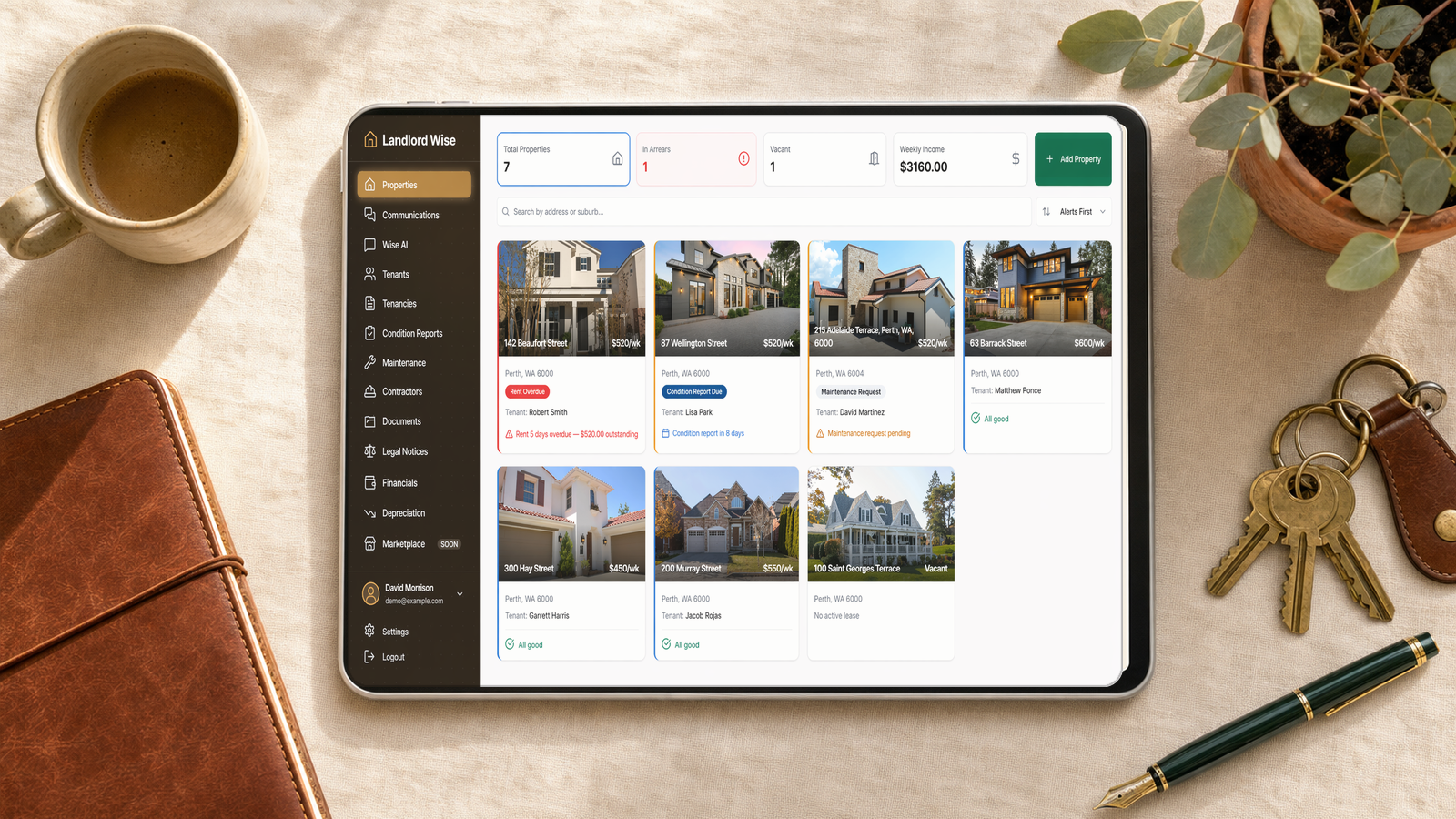
Landlord Wise is open to Australian landlords during early access. Register for free, choose your property state inside the app, and use the workflows to upload leases and documents, keep tenant and property records, manage rent schedules, track manual payments, record maintenance and organise evidence.
When to Get Professional Help
Self-management does not mean doing everything alone. Get professional help when:
- a tenant threatens legal action;
- you are unsure whether a notice is valid;
- there is a serious bond dispute;
- there is family violence, abandonment, injury, insurance or tribunal complexity;
- you are unsure about tax treatment or depreciation claims;
- the property is in a state where you have not checked current rules.
For legal questions, use the official tenancy authority or a lawyer. For tax questions, use a registered tax agent or accountant.
How Landlord Wise Helps Self-Managing Landlords
Landlord Wise is built for Australian self-managing landlords who want clearer workflows and better records.
Current public strengths include:
- guided lease, condition report and notice workflows shown according to the property state you choose in the app;
- uploaded existing lease and document management for records you already have;
- property, tenant, rent, maintenance and document records;
- manual rent tracking and arrears evidence;
- Wise AI tenancy guidance grounded in state legislation and product context;
- EOFY statements and separate depreciation tracking for review with your accountant.
The app shows the current workflow options after you choose the property’s state. The core role is useful nationally: keeping the tenancy organised with uploaded documents, rent records, maintenance history, communication evidence and supporting records.
Self-manage with clearer records
Use Landlord Wise to keep property, tenant, rent, maintenance and document records in one place, with guided workflows that help self-managing landlords stay organised.
Start free early accessFrequently Asked Questions
Can I manage my own rental property?
Yes. In Australia, a landlord can generally manage their own residential rental property. You still need to comply with your state or territory’s tenancy laws.
How do I self-manage a rental property?
Start by checking your state rules, setting up clean records, using the correct lease, completing the condition report, lodging the bond, tracking rent, responding to repairs, and using the correct process for rent increases and notices.
Do I need a property manager?
Not always. Many landlords self-manage successfully when they have a structured system for records, rent, inspections, maintenance and notices. A property manager may be useful if you want someone else to handle local attendance, formal notices, tribunal preparation or difficult tenant conversations.
Is it hard to self-manage a rental property?
It is manageable if you are organised. The hardest parts are knowing which forms and deadlines apply in your state, keeping records, and responding quickly when something goes wrong.
What records should a self-managing landlord keep?
Keep the lease, condition reports, bond records, rent ledger, maintenance requests, invoices, inspection notices, communications, insurance records, water/rates documents, formal notices and tax records.
What is the first step to self-managing a rental property?
Check the rules for the state where the property is located, then set up your record system before advertising or signing a lease.
What should be in a rental property management checklist?
A useful checklist should cover pre-advertising, tenant screening, lease setup, bond lodgement, condition reports, rent tracking, maintenance, inspections, notices, documents, tax records and end-of-tenancy evidence.
When should I get professional help?
Get professional help for legal disputes, unclear notices, tribunal matters, serious bond disputes, insurance issues, family violence situations, and tax or depreciation questions.
This guide is general information for Australian residential landlords. Tenancy law differs by state and territory and changes over time. It is informational in nature and does not constitute legal, financial or tax advice. Check the current rules for your state and seek professional advice for your situation.
Related Guides
Most useful next-step guides for landlords.

How to Self-Manage a Rental Property in WA
Learn how to self-manage a rental property in Western Australia. Covers landlord obligations, Form 1AA leases, condition reports, bonds, rent records and notices.
How to Self-Manage a Rental Property in NSW
Learn how to self-manage a rental property in New South Wales. Covers landlord obligations, tenancy agreements, condition reports, bonds, rent records and notices.
How to Self-Manage a Rental Property in QLD
Learn how to self-manage a rental property in Queensland. Covers landlord obligations, Form 18a leases, entry condition reports, bonds, rent records and notices.
How to Self-Manage a Rental Property in VIC
Learn how to self-manage a rental property in Victoria. Covers VIC rental provider duties, leases, condition reports, bonds, rent records, notices and reforms.
Self-Manage Rental Property SA: Landlord Checklist
SA landlord guide for self-managing a rental property: CBS forms, Form A1, Section 48, bonds, inspections, rent records, notices and SACAT evidence.
Self-Managing vs Property Manager WA: The Real Cost Comparison
Honest comparison of self-managing your rental property versus using a property manager in Western Australia. Covers real Perth fee structures, what a property manager actually does, what self-managing involves, and when each approach makes sense.
Turn this guide into an organised landlord workflow
Landlord Wise is free during early access. Register, choose your property state, and keep rent, documents, maintenance, deadlines and evidence organised.