
Free now + $150 launch offer coming soon
Use Landlord Wise free while you compare software options
Landlord Wise is free during early access with no credit card required. A $150 eGift card launch promotion is also planned for eligible landlords when Ezidebit PayTo and PayID rent payments go live.
This guide compares property management software in Australia for landlords who self-manage their own rental properties, rather than agencies managing rent rolls for clients. If you self-manage a rental, your software becomes part rent ledger, part document vault, part maintenance register, part reminder system, and part evidence file if a dispute later arises.
The best property management software depends on the job you need it to do. A landlord replacing an agent needs different support from an investor with one existing tenant, a landlord trying to advertise a vacant property, or a professional property manager running an agency rent roll.
This guide compares Australian property management software and adjacent landlord platforms that self-managing landlords are likely to see in 2026:
- Landlord Wise
- RentBetter
- RealRenta
- propkt
- Landlord Studio
- RentingSmart
- PropertyMe
The short version: choose the tool that matches your biggest risk. If your risk is getting state-specific tenancy steps wrong, look for guided Australian workflows. If your risk is finding a tenant, look for advertising and onboarding. If your risk is tax time, look for strong income, expense, depreciation and reporting tools. If you need agency trust accounting, you are probably looking at professional property manager software rather than a small-portfolio self-management tool.
Who this guide is for
This comparison is for Australian landlords who self-manage, or are deciding whether to self-manage, their own rental properties. It is not written for real estate agencies choosing rent-roll software for professional property managers.
That distinction matters. Agency property management software usually focuses on trust accounting, office workflows, owner statements, agency staff, and large portfolios. A self-managing landlord usually needs simpler tools for leases, rent records, condition reports, notices, maintenance, documents, tax records, tenant communication, and state-specific compliance.
PropertyMe is included because it appears in broad searches for “property management software Australia”, but it is treated separately because it is mainly agency and professional property manager software.
Methodology and transparency
This comparison is based on publicly available product pages reviewed on 16 May 2026, with RentingSmart rent-collection claims rechecked against its own FAQ and pricing pages on 3 June 2026 and tenant-portal availability updated on 7 July 2026. Landlord Wise is our own product, so we include both strengths and limitations. Products are grouped by relevance to self-managing landlords, not by sponsorship or affiliate payment. Features and pricing can change, so check each provider before choosing.
Competitor comparison pages are not used as the source of truth for third-party feature claims; where possible, each provider’s own public pages, FAQs and pricing pages are preferred.
We have kept the comparison practical rather than hostile. The right choice depends on whether you care most about compliance workflows, listing a vacant property, rent collection, tax records, mobile bookkeeping, or agency-scale operations.
Quick recommendation
| Software | Best for | Main strength | Watch-out |
|---|---|---|---|
| Landlord Wise | Self-managing landlords who want guided Australian tenancy workflows | Lease workflows, notice records, condition-report workflows, AI photo descriptions, rent records, documents, maintenance, tenant portal, income/expense records, separate depreciation schedules, and Wise AI guidance | Early access is open to Australian landlords |
| RentBetter | Landlords who need to advertise, find a tenant, and manage the tenancy lifecycle | Listing syndication, tenant checks, lease setup, rent collection, condition reports, messaging, and records | Check current plan inclusions, listing fees, and per-property costs before choosing |
| RealRenta | Landlords who want rent payments, advertising support, and arrears workflows | BPAY/direct debit positioning, rent ledger, maintenance, advertising, and arrears notifications | No dedicated tenant portal; less visibly compliance-led by state than Landlord Wise |
| propkt | Investors focused on tax records, deductions, depreciation, and accountant-ready reporting | Expense records, depreciation, documents, maintenance, payment tracking, and tax-package export | No tenant portal; more tax-led than tenant-operations-led |
| Landlord Studio | Landlords who want mobile-first accounting, receipt capture, and reporting | Income and expense tracking, reports, receipts, reminders, documents, and mobile app | Global product; payment, bank-feed and Australian tenancy workflow fit should be checked |
| RentingSmart | Landlords who want a simple self-management hub | Rent schedules, invoices, receipts, dashboards, reminders, maintenance, documents, communication, inspections, advertising, and savings positioning | No tenant portal and no rent collection; landlords collect funds separately |
| PropertyMe | Professional property managers and agencies | Trust accounting, rent-roll operations, agency workflows, owner/tenant portals, and portfolio management | Usually overbuilt for a small self-managing landlord |
Feature comparison matrix
| Feature | Landlord Wise | RentBetter | RealRenta | propkt | Landlord Studio | RentingSmart | PropertyMe |
|---|---|---|---|---|---|---|---|
| Self-managing landlord focus | Yes | Yes | Yes | Yes | Yes, with global focus | Yes | No, mainly agency/professional PM |
| Rent tracking | Yes | Yes | Yes | Yes, payment tracking | Yes | Yes, schedules/dashboards | Yes |
| Automated payment rail | PayTo (NPP real-time) roadmap, with manual rent tracking for externally collected rent | Direct debit/card collection described publicly | BPAY/direct debit positioning | Not the main focus | Online collection listed in supported regions; check Australia fit | No direct debit or payment collection; landlords collect funds separately while the platform supports schedules, invoices, receipts and reminders | Agency payment workflows |
| Rent collection records | Rent records, rent schedules, manual payment tracking and arrears evidence | Yes, positioned publicly around rent collection | Yes, BPAY/direct debit positioning | Payment tracking, not the main focus | Available in supported regions; check Australia fit | Rent schedules, dashboards, invoices, receipts, reminders and external-payment tracking | Agency payment workflows |
| Lease generation | Guided lease workflows and existing signed lease upload for Australian landlords | Yes | Check current inclusions | Not the main focus | E-sign lease features listed, check Australia fit | Legal documents listed | Agency workflows |
| Condition reports | Written condition report workflows with AI photo descriptions as supporting evidence | Yes | Check current inclusions | Not the main focus | Not Australian-form-led | Inspection reports listed | Agency workflows |
| Legal notices | Notice workflows and document records guided by the property state inside the app | Check current workflow depth | Arrears notices listed; landlord should verify state requirements | Not the main focus | Reminders/documents more than Australian notices | Legal documents listed | Agency workflows |
| AI guidance | Wise AI tenancy guidance and AI condition-report photo descriptions | Not visibly core | Not visibly core | Not visibly core | Not visibly core | Not visibly core | Not visibly core |
| Tax/depreciation | Income and expense records, EOFY statement generation and separate depreciation schedules | Expenses and reports | Records and reports | Strong tax and depreciation positioning | Strong accounting and reporting positioning | Tax-deductible expenses listed | Agency reporting |
| Tenant portal | Yes | Yes | No | No | Tenant-related tools vary by region | No | Yes |
| Advertising/listing support | Not core currently | Strong | Yes | Not core | Not core | Yes | Agency workflows |
| Agency trust accounting | No | No | No | No | No | No | Yes |
What property management software needs to do for landlords
For Australian self-managing landlords, useful rental property software should cover more than contacts and a notes field. At minimum, compare whether each product helps with:
- Property and tenant records
- Lease dates, rent amount, rent frequency, and fixed-term or periodic status
- Rent tracking, arrears visibility, receipts, and rent ledger history
- Whether rent collection is manual tracking, legacy direct debit/card/BPAY, or a newer PayTo/NPP-style automated payment rail
- Bond information and evidence, including state-specific rules such as NSW rental bond requirements, QLD rental bond requirements and VIC rental bond requirements
- Entry condition reports, routine inspections, exit records, and photos as supporting evidence, including written report workflows such as NSW condition reports, QLD condition reports and VIC condition reports
- Maintenance requests, contractor details, invoices, and repair history
- Legal notices, rent increase dates, and state-specific notice periods, including state guides for NSW, QLD and SA notice workflows
- Document storage for leases, reports, notices, insurance, invoices, and correspondence
- Income and expense records, EOFY statement generation/download, and separate depreciation schedules
- State-specific tenancy law differences across WA, NSW, QLD, VIC, SA, TAS, ACT, and NT
If you are comparing software against hiring an agent, use the property management savings calculator and the Australian self-management guide, plus state guides for NSW, QLD and VIC.
1. Landlord Wise
Best for: Australian self-managing landlords who want guided tenancy workflows, forms, records, notices, maintenance, documents, and compliance steps.
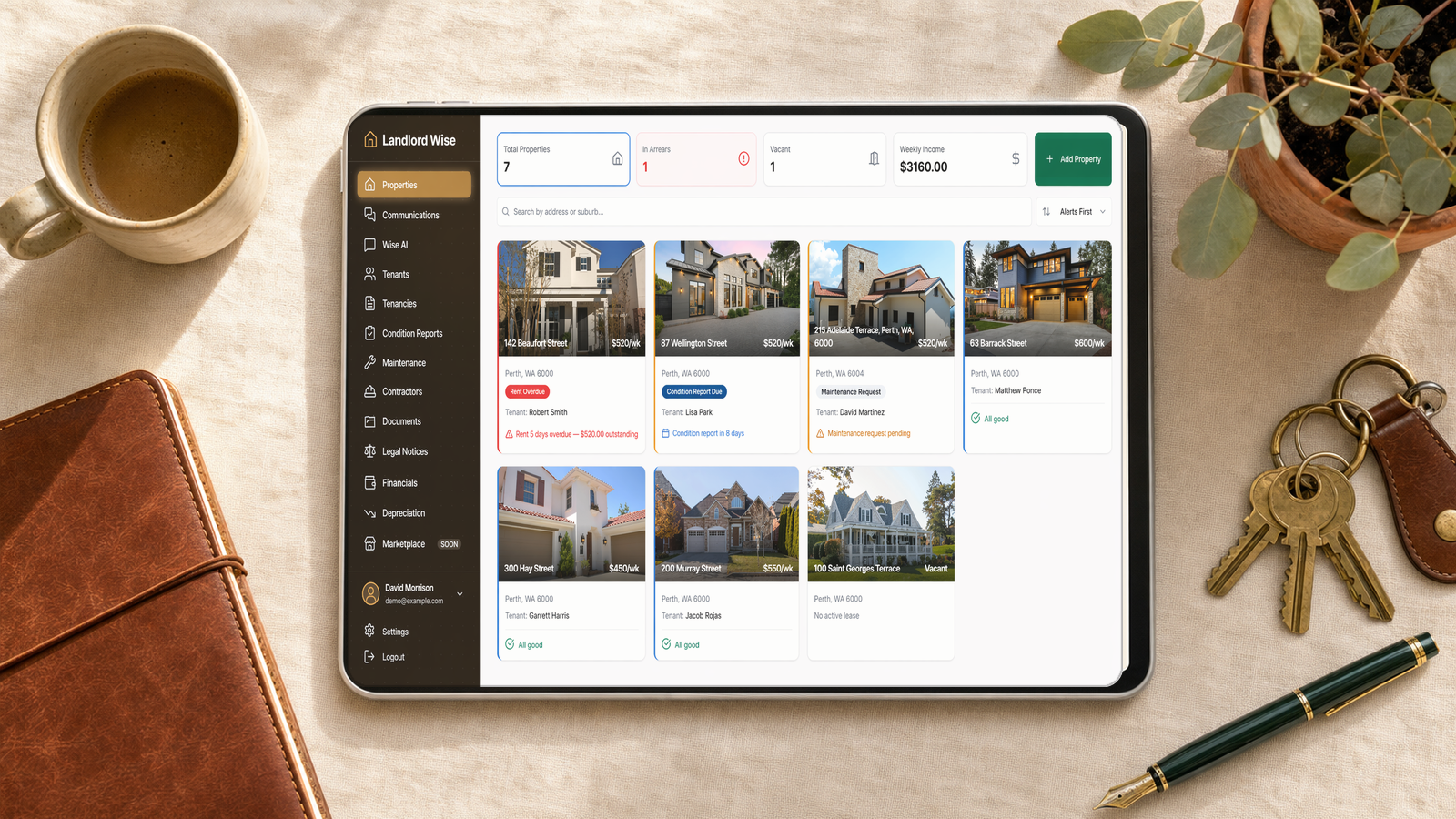
Landlord Wise is built for landlords who want to self-manage without relying on spreadsheets, generic file storage, or memory. The product focus is practical tenancy management: setting up a lease, keeping records, completing condition reports, handling maintenance, keeping notice records, storing documents, and getting tenancy-law answers grounded in Australian source material.
The strongest reason to choose Landlord Wise is that it is workflow-led rather than only accounting-led. A rent ledger is useful, but self-managing also means knowing which form to use, when a notice can be served, what evidence to keep, and how to maintain a clear record if a dispute later goes to a tribunal or court.
Current public product strengths include:
- Guided lease workflows and existing signed lease upload for landlords who already have a lease
- Written condition report workflows, including AI-generated photo descriptions as supporting evidence
- Notice workflows and document records guided by the property state inside the app
- Rent records, documents, maintenance, tenant records, and tenant communication
- PayTo automated rent collection built around Australia’s real-time NPP payment rail is being rolled out; manual rent tracking remains available today
- Tenant portal access for tenant-facing workflows and shared records
- Income and expense records, EOFY statement generation/download, and separate depreciation schedules
- Wise AI tenancy guidance using state-specific source material
Landlord Wise is open during early access for Australian landlords to create an account, choose their property state, and continue with lease, condition report, notice, rent, document and maintenance workflows inside the app.
For automated rent collection, Landlord Wise is building around PayTo rather than legacy direct debit, while manual rent tracking keeps externally collected payments in the tenancy record.
Pros:
- Built for Australian self-managing landlords
- Strong fit for Australian landlords who want guided forms, notices, records, and compliance workflows
- Lease, notice and condition-report workflows guided by the property state inside the app
- AI condition-report photo descriptions as supporting evidence
- Rent records, documents, maintenance, tenant records, tenant portal, and communications in one place
- Manual rent tracking for externally collected rent, with PayTo rent collection on Australia’s newer real-time payment rail on the roadmap
- Wise AI can answer tenancy questions using state-specific corpus material
- Includes income and expense records, EOFY statement generation/download, and separate depreciation schedule tools alongside tenancy workflows
Cons:
- Newer product than longer-established listing and payment platforms
- Not an agency trust-accounting system
- Not currently positioned as a property advertising/listing platform
- Landlords needing tenant advertising and screening immediately may still use a listing-focused tool
- Manual rent tracking is the practical baseline for externally collected rent
Choose Landlord Wise if you want a self-management operating system that helps with the forms, deadlines, records, and compliance work that a property manager would normally handle.
Useful Landlord Wise guides:
- How to self-manage a rental property in Australia
- How to self-manage a rental property in NSW
- How to self-manage a rental property in QLD
- How to self-manage a rental property in VIC
- Lease agreement guides for NSW, QLD and VIC
- Condition report guides for NSW, QLD and VIC
- Rental bond guides for NSW, QLD and VIC
- Eviction notice guides for NSW, QLD and SA
- Rent increase guides for NSW, QLD and VIC
Self-manage with guided Australian workflows
Landlord Wise helps self-managing landlords keep leases, condition reports, notice records, rent records, documents, maintenance, tenant communication, and tenancy-law questions in one place.
Start free early access2. RentBetter
Best for: Landlords who want help finding a tenant and managing the tenancy lifecycle.
RentBetter is one of the more established self-management platforms in Australia. Its public pages describe features such as advertising on major Australian property sites, tenant checks, lease creation and signing, bond setup, condition reports, rent collection, expenses, tenant bills, messaging, reports, document storage, repairs, inspections, and reminders.
RentBetter is strongest when you need help replacing the operational side of a property manager during a vacancy. If you are moving away from an agent and need to advertise, collect enquiries, screen applicants, create a lease, and manage rent, RentBetter is built around that path.
Pros:
- Strong tenant acquisition and onboarding workflow
- Advertising on major Australian property websites
- Lease creation and signing
- Rent collection, reminders, receipts, and tenant messaging
- Condition reports, maintenance, documents, and reports
Cons:
- Check current plan inclusions and any extra charges before choosing
- Less focused on AI-guided legal/compliance assistance than Landlord Wise
- Landlords who already have a tenant may not need the full listing and onboarding feature set
RentBetter is a good option if your biggest need is finding and onboarding tenants, especially when replacing what an agent normally does during a vacancy.
3. RealRenta
Best for: Landlords who want payment automation, advertising support, and arrears workflows.
RealRenta is positioned toward owners and self-managed landlords. Its public owner pages describe BPAY and direct debit rent payments, automatic rent tracking, rental ledgers, invoices, receipts, maintenance requests, tenant communication, advertising, tenant checks, document storage, and arrears notifications.
RealRenta is strongest if your biggest pain is operational automation: getting rent paid, keeping the ledger updated, advertising the property, and triggering reminders or arrears steps when something is missed.
Pros:
- Built for owners and self-managed landlords
- BPAY and direct debit rent payment positioning
- Rental ledger, invoices, receipts, and arrears visibility
- Maintenance request and document storage workflows
- Advertising support across multiple rental platforms
Cons:
- Listing and payment costs should be checked before choosing
- Less focused on state-specific legal guidance than Landlord Wise
- Automated notices still need landlord review because notice requirements vary by state
RealRenta is a good option if rent collection, arrears automation, and advertising are more important to you than guided state-specific compliance. It should not be treated as a tenant-portal product.
4. propkt
Best for: Landlords who care most about tax records, depreciation, and accountant-ready reporting.
propkt positions itself as rental property management and tax tracking software for Australian landlords. Its public homepage focuses heavily on self-management, deductions, depreciation, expenses, documents, maintenance, payment tracking, and tax-package export.
This makes propkt a strong option for landlords whose pain is tax time: missing deductions, tracking receipts, maintaining depreciation records, and preparing accountant-friendly reports.
Pros:
- Australian landlord tax and depreciation focus
- Expense, document, maintenance, tenant, payment tracking, and tax package export positioning
- Useful if the main goal is cleaner financial records for the accountant
Cons:
- More tax-led than tenancy-compliance-led
- No tenant portal; not positioned as the strongest option for rent collection or tenant-facing operations
- Landlords needing state-specific lease, notice, and condition-report workflows may still need another tool
propkt is a good option if you already have your tenancy operations under control and mainly want better financial records and depreciation support.
5. Landlord Studio
Best for: Mobile-first landlords who want accounting, receipt capture, rent records, and reporting.
Landlord Studio is a global rental property software platform with a strong accounting and mobile-app angle. Its public feature pages highlight income and expense tracking, reporting, receipt scanning, bank feeds, online rent collection, mileage tracking, document storage, reminders, and e-sign leases.
For Australian landlords, the main question is whether you want a global rental accounting app or a tool built around Australian tenancy workflows. Landlord Studio can be useful for financial organisation and mobile receipt capture, but bank feeds and online rent collection should be checked for local availability because its public payment copy is framed around ACH/card collection for USA landlords.
Pros:
- Mature mobile-first product
- Good accounting, receipt, and reporting focus
- Useful for landlords with properties across more than one country
- Document storage, reminders, and reporting features
Cons:
- Not designed primarily around Australian state tenancy forms
- Australian landlords should check reporting fit with their accountant
- Less focused on Australian legal notice and condition-report workflows
Landlord Studio is a good option if your priority is mobile accounting and receipt capture, especially if you are comfortable adapting reports for Australian tax and tenancy requirements.
6. RentingSmart
Best for: Landlords who want a simple self-management platform with tenant communication and document organisation.
RentingSmart describes itself as property management software for self-managing landlords. Its public site focuses on reducing property manager fees, advertising rental properties, tracking payments, organising maintenance history, repairs, bond information, tax deductible expenses, inspection reports, tenant communication, and legal documents.
The positioning is similar to RentBetter in that it supports self-management rather than agency trust accounting. It appears more tenant-relationship and organisation focused than tax-heavy.
The rent-collection limitation matters. RentingSmart’s own FAQ says it does not collect rent for landlords or authorise direct debit on their behalf. Landlords collect rent separately, while RentingSmart helps with rent schedules, invoices, receipts, reminders, paid status and arrears visibility.
Pros:
- Built for self-managing landlords
- Tenant communication and document organisation
- Maintenance, payments, bond, inspections, and legal documents in one place
- Strong self-management savings message
Cons:
- Public pricing and feature depth can be harder to assess before signup
- No tenant portal
- No automated rent debit or payment collection; rent collection remains the landlord’s responsibility
- Less visible detail on state-specific legal workflows than Landlord Wise or RentBetter
- Less tax/depreciation positioning than propkt
RentingSmart may suit landlords who want a straightforward self-management hub and tenant communication system.
What about PropertyMe?
Best for: Professional property managers and agencies, not most individual self-managing landlords.
PropertyMe is a major Australian property management platform used by real estate agencies and professional property managers. Its public homepage is framed around property managers, agencies, offices, rent rolls, trust accounting, owner/tenant portals, and portfolio operations.
For a landlord self-managing one or two properties, PropertyMe is usually more software than you need. It is powerful, but the problem it solves is agency-scale property management rather than individual compliance and record keeping.
Pros:
- Mature Australian property management platform
- Built for professional portfolios
- Trust accounting, agency workflows, owner/tenant portals, and operations
Cons:
- Generally overbuilt for self-managing landlords with small portfolios
- Not positioned primarily as a small self-management tool
- Agency-grade tools may add complexity that self-managers do not need
PropertyMe is worth mentioning because it appears for broad “property management software Australia” searches. But for this comparison, it should not be treated as a top self-managing landlord option. It is best if you are running a property management business or need agency-grade systems, not if you simply want to self-manage your own rental property.
Best software by landlord type
| Landlord type | Best fit | Why |
|---|---|---|
| Landlord replacing an agent | Landlord Wise or RentBetter | Landlord Wise for compliance-led workflows; RentBetter for listing and onboarding |
| Landlord with an existing tenant | Landlord Wise, RealRenta, propkt, or RentingSmart | The need is usually records, reminders, documents, rent tracking, external-payment tracking, tax records, and compliance |
| Landlord with a vacancy | RentBetter or RealRenta | Both support advertising and tenant onboarding; compare listing costs and workflow fit |
| Landlord focused on rent payments and arrears | RealRenta | Strong public positioning around payment options, ledgers, reminders, and arrears automation |
| Tax-focused investor | propkt or Landlord Studio | Stronger focus on expenses, deductions, receipts, depreciation, and reporting |
| Landlord worried about forms and notices | Landlord Wise | State-aware legal workflow is the differentiator |
| Professional property manager | PropertyMe | Agency-grade platform rather than a small self-management tool |
What to check before choosing
Before you choose property management software, ask:
- Is it built for self-managing landlords or for agencies?
- Does it support your state or territory?
- Does it help with the actual forms you need, or only store documents after you create them somewhere else?
- Can it track rent, arrears, and payment history clearly enough to use as evidence?
- Can you export records for your accountant?
- Does it handle condition reports as written form-based records, with photos as supporting evidence?
- Does it remind you before key dates such as lease expiry, rent review, inspections, or document expiry?
- Does it support your workflow if the tenant stops paying rent?
- Does the pricing model make sense for your number of properties?
- Can you keep using it if you add more properties?
The mistake is choosing software just because it has the most features. A self-managing landlord needs the right features: rent records, legal documents, deadlines, evidence, and state-specific workflows.
Our recommendation
If you are self-managing in Australia, start with your biggest pain point.
Choose Landlord Wise if you want guided landlord workflows, tenancy-law support, rent records, documents, maintenance, notice records, and condition reports in one Australian compliance-first tool.
Choose RentBetter if you need help finding a tenant, listing the property, screening applicants, creating a lease, and collecting rent through a mature self-management platform.
Choose RealRenta if your priority is rent payments, advertising support, ledgers, and arrears automation.
Choose propkt if your main pain is tax time, depreciation, expenses, and accountant-ready reporting.
Choose Landlord Studio if you want mobile-first accounting and receipt capture, particularly if you manage property across multiple countries.
Choose PropertyMe if you are a professional property manager or agency, not a small self-managing landlord.
For many landlords, the best answer is not “the biggest platform.” It is the platform that reduces the most risk in the way you actually manage your rental.
Sources checked
Feature notes were originally reviewed on 16 May 2026 from public product pages. RentingSmart rent-collection details were rechecked on 3 June 2026, and tenant-portal availability was updated on 7 July 2026:
- RentBetter pricing
- RentBetter rental payments
- RentBetter rental payments help article
- RealRenta owner features
- RealRenta pricing
- propkt homepage
- Landlord Studio rental accounting features
- Landlord Studio online rent collection features
- RentingSmart homepage
- RentingSmart FAQ
- RentingSmart pricing
- Australian Payments Plus PayTo for businesses
- PropertyMe homepage
Frequently asked questions
What is the best property management software in Australia for landlords?
There is no single best option for every landlord. Landlord Wise is strongest for compliance-led self-management and tenant portal workflows, RentBetter is strong for listing and tenant onboarding, RealRenta is strong for payments and arrears workflows, propkt is strong for tax and depreciation, Landlord Studio is strong for mobile accounting, and PropertyMe is built mainly for professional agencies.
Is PropertyMe suitable for self-managing landlords?
PropertyMe can appear in broad property management software searches, but it is mainly agency and professional property manager software. A small self-managing landlord will usually find a landlord-focused product simpler and more relevant.
What features matter most for self-managing landlords?
The most important features are rent records, lease dates, document storage, condition reports, maintenance history, reminders, state-specific notices, bond evidence, tenant communication, and EOFY records. Advertising and rent collection matter more if you are replacing an agent during a vacancy.
Do I still need a property manager if I use property management software?
Not always. Many landlords self-manage successfully with good records, clear processes, and the right software. A property manager may still be useful if you want someone else to handle inspections, tenant issues, vacancy leasing, tribunal appearances, or day-to-day administration.
Is property management software cheaper than a property manager?
Usually, but it depends on your rent, agent fees, leasing fees, inspection fees, and how much work you are willing to do yourself. Use the property management savings calculator to estimate the difference for your property.
Should I choose software with rent collection built in?
Choose rent collection if payment automation is your main pain point. Some landlords are comfortable receiving rent by bank transfer and using software to track payments and arrears. Others prefer direct debit, BPAY, or platform-based payment workflows. The right choice depends on whether you value payment automation more than legal workflow support, tax reporting, tenant portal access, or document management.
Can I use more than one property management app?
Yes. Some landlords use one tool for tenant onboarding or rent collection and another for tax records or compliance documents. The downside is double handling. If you can keep the core tenancy record in one place, your evidence and reporting will usually be cleaner.
This guide is general information for Australian landlords and is based on public product information available on 16 May 2026, with RentingSmart rent-collection details rechecked on 3 June 2026 and tenant-portal availability updated on 7 July 2026. Software features and pricing change, so check each provider’s current website before choosing a platform.
More Software Comparison Guides
For readers already comparing software options.
Best Landlord Software in Australia (2026)
Compare landlord software for Australian self-managing landlords, including Landlord Wise, RentBetter, RealRenta, propkt, Landlord Studio and RentingSmart.
Best Rental Property Tax Software for Australian Landlords (2026)
Compare rental property tax software for Australian landlords, including Landlord Wise, propkt, Landlord Studio, TaxTank, Xero, MYOB and QuickBooks.
Best Rent Collection Apps for Australian Landlords (2026)
Compare rent collection apps for Australian landlords, including RentBetter, RealRenta, RentingSmart, Ailo, Managed App and Landlord Wise.
Best RentBetter Alternatives for Australian Landlords (2026)
Compare RentBetter alternatives for Australian landlords, including Landlord Wise, RealRenta, propkt, Landlord Studio and RentingSmart.
Related Guides
Most useful next-step guides for landlords.
How to Self-Manage a Rental Property in Australia (2026 Guide)
Learn how to self-manage a rental property in Australia, including tenant screening, leases, bonds, condition reports, rent records, maintenance and state rules.

How to Self-Manage a Rental Property in NSW
Learn how to self-manage a rental property in New South Wales. Covers landlord obligations, tenancy agreements, condition reports, bonds, rent records and notices.
How to Self-Manage a Rental Property in QLD
Learn how to self-manage a rental property in Queensland. Covers landlord obligations, Form 18a leases, entry condition reports, bonds, rent records and notices.
How to Self-Manage a Rental Property in VIC
Learn how to self-manage a rental property in Victoria. Covers VIC rental provider duties, leases, condition reports, bonds, rent records, notices and reforms.

NSW Residential Tenancy Agreement Guide
How to complete the NSW residential tenancy agreement step by step. Updated April 2026. Covers standard terms, bond rules, rent payments, pet provisions, and the 2024-2026 rental reforms — built for NSW landlords.
QLD Lease Agreement (Form 18a) Guide
Set up a compliant tenancy agreement in Queensland. Covers Form 18a, bond, condition reports, rent, rental application, pets, and 2024–2025 law changes.
VIC Residential Rental Agreement Guide
Guide to VIC residential rental lease agreements for landlords: required terms, prescribed form, fixed-term vs periodic agreements, special conditions and compliance risks.

Rental Bond NSW — Complete Guide for Self-Managing Landlords
How rental bonds work in NSW. Bond limits, lodgement deadlines, Rental Bonds Online, claims, disputes, and the mandatory end-of-tenancy survey.
Rental Bond QLD — Complete Guide for Self-Managing Landlords
How to handle rental bonds in Queensland. Covers maximum bond amounts, RTA lodgement, the 10-day rule, refund process, dispute resolution, bond claims with evidence requirements, excess bonds, and the 2024 reform changes. Updated April 2026.