
Free now + $150 launch offer coming soon
Use Landlord Wise free while you compare software options
Landlord Wise is free during early access with no credit card required. A $150 eGift card launch promotion is also planned for eligible landlords when Ezidebit PayTo and PayID rent payments go live.
Rental property tax software helps Australian landlords keep better records for income, expenses, deductions, depreciation and accountant handover. But tax software is only one part of self-managing a rental property. If a dispute or arrears issue arises, your accountant reports will not replace your lease evidence, condition reports, notices, maintenance history or tenant communication records.
This guide compares rental property tax software and accounting tools through a landlord lens: not just “can it produce tax records?”, but “does it keep the tenancy evidence that supports the tax record?”
Methodology and transparency
This comparison is based on publicly available product pages reviewed on 16 May 2026, with source links and selected tax/accounting claims spot-checked against provider-owned pages on 3 June 2026 and tenant-portal availability updated on 7 July 2026. Landlord Wise is our own product, so we include both strengths and limitations. Features and pricing can change.
Products are grouped by relevance to Australian rental-property tax workflows, not by sponsorship or affiliate payment. Competitor comparison pages are not used as the source of truth for third-party feature claims; where possible, each provider’s own public pages, FAQs, support articles and pricing pages are preferred. Competitor source links are kept in the Sources checked section near the bottom.
Quick picks
| Product | Best for | Main tax strength | Main limitation for landlords |
|---|---|---|---|
| Landlord Wise | Landlords who want tax records plus tenancy evidence | Income and expense records, EOFY statement generation/download, separate depreciation schedules and supporting tenancy records | Not a full accounting platform; depreciation does not automatically flow into the EOFY statement |
| propkt | Tax-led self-managing landlords | Tax package export, depreciation, expenses, documents and accountant sharing | No tenant portal; less focused on state-specific tenancy forms and notices |
| Landlord Studio | Mobile bookkeeping and receipts | Income, expenses, receipt capture, reports and bank feeds listed | Global product; bank-feed, rent-collection and Australian tenancy workflow fit should be checked |
| TaxTank | Property investors who want deeper tax modelling | Real-time tax position, depreciation, CGT and bank feeds | Tax platform more than tenancy-management platform |
| Xero | Landlords already using small-business accounting software | Bank feeds, accounting reports, invoicing and app integrations | Not landlord-compliance software by itself |
| MYOB | Australian business accounting users | General accounting, GST/BAS/payroll style business features | Not built specifically around landlord tenancy records |
| QuickBooks | Small-business accounting users | General bookkeeping, invoicing, expenses and reporting | Not Australian tenancy workflow software |
What tax software must capture
For Australian rental properties, a useful tax record usually includes:
- Rental income by property
- Water or other tenant reimbursements
- Repairs and maintenance expenses
- Council rates, insurance, strata/body corporate, land tax and interest
- Non-deductible items separated from deductible expenses
- Receipts and invoices attached to expense records
- Australian financial-year reporting
- Depreciating assets and capital works records
- Accountant handoff records or a clean EOFY statement
But good tax records work best when they sit beside tenancy records. A repair invoice is easier to explain when it links to a maintenance request. A rent ledger is more useful when it ties back to the lease. A deduction is easier to defend when the underlying document is stored.
Feature comparison
| Feature | Landlord Wise | propkt | Landlord Studio | TaxTank | Xero | MYOB | QuickBooks |
|---|---|---|---|---|---|---|---|
| Rental income tracking | Yes | Yes | Yes | Yes | Yes | Yes | Yes |
| Expense tracking | Yes | Yes | Yes | Yes | Yes | Yes | Yes |
| Australian financial year focus | Yes | Yes | Check setup | Yes | Yes, via AU product | Yes | Yes, via AU product |
| EOFY statement/export | Statement generation/download | Tax package export | Reports | Tax reports | Reports | Reports | Reports |
| Depreciation records | Separate depreciation schedules | Strong public focus | Not core Australian depreciation | Strong public focus | Usually external/manual | Usually external/manual | Usually external/manual |
| CGT modelling | No | Not main public focus | No | Yes, public focus | Usually external/manual | Usually external/manual | Usually external/manual |
| Receipt storage | Yes | Yes | Yes | Yes | Yes | Yes | Yes |
| Accountant access/export | Export/reporting | Shared access/export | Reports | Accountant collaboration | Accountant access | Accountant access | Accountant access |
| Lease and tenancy evidence | Yes | Lease tracking/documents | Documents/lease features | Not tenancy-led | Not by itself | Not by itself | Not by itself |
| Condition reports | Written condition report workflows with AI photo descriptions as supporting evidence | Not core | Not Australian-form-led | No | No | No | No |
| Legal notices | Supported notice workflows and document records | Not core | No | No | No | No | No |
1. Landlord Wise
Best for: Self-managing landlords who want tax records connected to tenancy records.
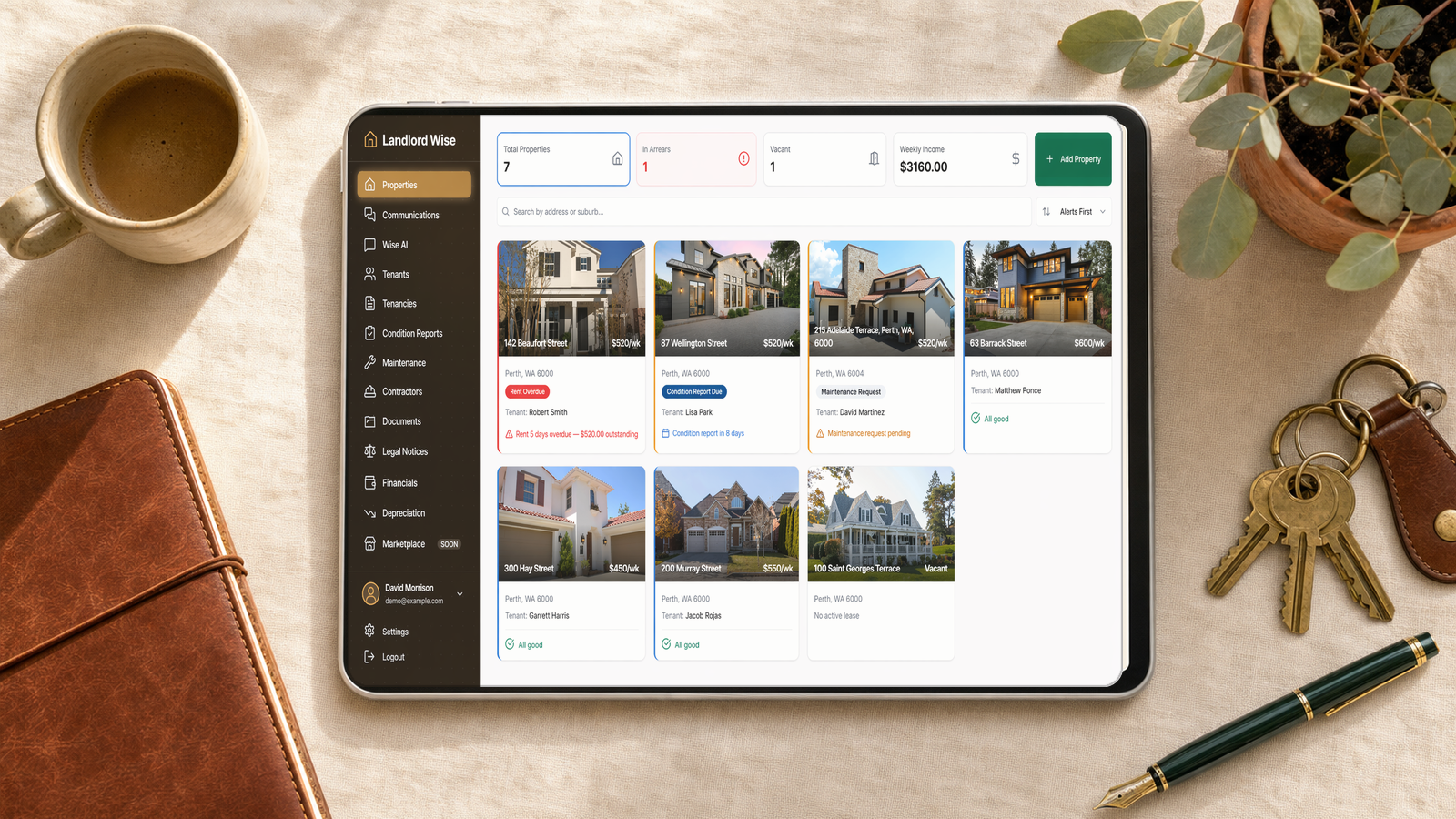
Landlord Wise goes beyond a standalone tax app: it is a self-management platform with financial records inside the tenancy workflow. That matters because tax time is easier when the lease, rent ledger, maintenance request, repair invoice, condition report and tenant correspondence can all sit in the same evidence trail.
Current public financial strengths include income and expense tracking, rent ledger records, tenant bills, EOFY statement preview/generation/download, property-level financial records and a separate depreciation section for Division 40 and Division 43 schedules.
The boundary is clear: Landlord Wise is a landlord self-management system rather than a full accounting package like Xero, MYOB or QuickBooks, and depreciation schedules are kept separate from the EOFY statement. Depreciation figures should be reviewed with an accountant before claiming.
Landlord Wise is a good fit if you want tax records and tenancy records together, especially if you also need guided lease workflows, notice records, condition reports, maintenance records and document storage. Because early access is free, landlords can create an account, choose their property state, and continue inside the app.
For related planning, use the rental property depreciation calculator, rental property cash flow calculator and negative gearing calculator.
2. propkt
Best for: Landlords who want a tax-first property management app.
propkt is one of the most directly relevant competitors for this search intent. Its public pages are built around tax package export, depreciation schedules, income, expenses, receipts, document storage, maintenance, payment tracking and accountant or co-owner access.
This makes propkt a strong choice if the main problem is getting tax records in order and reducing accountant handover friction. The trade-off is that propkt appears more tax-led than tenancy-compliance-led and should not be treated as a tenant-portal product. Landlords who need generated state-specific lease or notice workflows should check whether it covers those operational requirements.
3. Landlord Studio
Best for: Mobile-first bookkeeping, receipts and reports.
Landlord Studio publicly positions itself around rental accounting, bank feeds, receipt scanning, reports, income and expense tracking, documents and mobile access. It can be useful for landlords who want a dedicated rental bookkeeping app rather than a general accounting system.
Australian landlords should confirm how well the reports, categories, bank feeds and rent collection features fit Australian tax and tenancy needs. It is a global product, and its public rent-collection copy is framed around ACH/card collection for USA landlords, so local tenancy-form depth and local payment availability should be checked before relying on those features.
4. TaxTank
Best for: Property investors who want deeper tax modelling beyond the tenancy file.
TaxTank is highly relevant for the tax-specific intent. Its public pages focus on property tax visibility, bank feeds, real-time tax position, depreciation, CGT, ownership apportionment, document storage and accountant collaboration.
TaxTank may be the better choice if you are thinking like a property investor managing tax position, CGT, negative gearing and multi-income tax planning across your whole financial life.
The trade-off is tenancy operations. TaxTank is not primarily positioned as a lease, condition report, notice, maintenance and tenant portal workflow system for self-managing landlords.
5. Xero, MYOB and QuickBooks
Best for: General accounting users who already have a bookkeeping stack.
General accounting platforms can be useful for landlords who want bank feeds, invoicing, expense categorisation and accounting reports. Xero has an Australian landlord/property manager page and app integrations. MYOB and QuickBooks are also common accounting tools for Australian small businesses.
The limitation is that general accounting software usually does not solve the rental management problem by itself. It may record income and expenses, but it will not usually run guided lease, notice or condition report workflows, or preserve tenant dispute evidence in a tenancy-specific structure.
For landlords with accountants, a common setup is to use accounting software for the ledger and landlord software for the tenancy record. The best choice depends on whether the landlord wants one practical self-management workspace or a more traditional accounting stack.
Tax software is not the whole landlord file
Tax records are important, but they are not the only records that matter.
If a tenant stops paying rent, you need a rent ledger and evidence trail. If a bond dispute happens, you need the condition report and photos. If a repair is claimed as a deduction, the maintenance request, invoice, receipt and communication history help explain the expense.
That is the reason Landlord Wise positions tax and depreciation alongside tenancy workflows, not as a stand-alone bookkeeping silo. A landlord choosing software should ask whether the product helps with the full record, not only the accountant export.
Recommendation
Choose Landlord Wise if you want tax records connected to the day-to-day tenancy file: leases, rent records, documents, maintenance, notice records, condition reports and Wise AI guidance.
Choose propkt if the strongest need is a tax package, depreciation and accountant-ready records inside a landlord-focused app.
Choose TaxTank if your main need is broader property tax modelling, CGT, bank feeds and real-time tax visibility.
Choose Landlord Studio if mobile bookkeeping, receipt capture and reports matter more than Australian state-specific tenancy workflows.
Choose Xero, MYOB or QuickBooks if you already run your finances through a general accounting platform and are comfortable managing tenancy records elsewhere.
Sources checked
Feature notes were originally reviewed on 16 May 2026 from public product pages. Source links and selected tax/accounting claims were spot-checked on 3 June 2026, and tenant-portal availability was updated on 7 July 2026:
- propkt homepage
- propkt tax package export
- propkt depreciation schedules
- propkt payment tracking
- Landlord Studio rental accounting features
- Landlord Studio online rent collection features
- TaxTank property tax software
- TaxTank rental property accounting software article
- Xero accounting software for landlords
- MYOB accounting software
- MYOB bank feeds
- QuickBooks Australia features
Frequently asked questions
What is the best rental property tax software in Australia?
The best product depends on whether you want tax-only records or a broader landlord file. propkt and TaxTank are strong tax-led options. Landlord Wise is stronger when you want tax records connected to tenancy workflows, documents, maintenance and evidence.
Does Landlord Wise include depreciation tools?
Yes. Landlord Wise has a separate depreciation section for Division 40 and Division 43 records and forecasts. Depreciation is not automatically included in the EOFY statement, so landlords should review figures with their accountant before claiming.
Can I use Xero for rental property tax records?
Yes, many landlords can use Xero for income, expenses, bank reconciliation and reports. It is general accounting software, so you may still need a separate system for leases, condition reports, notices, maintenance evidence and tenant communication.
Do I still need an accountant?
Software can organise records, but many landlords still use an accountant for tax return preparation, depreciation advice, CGT issues, ownership apportionment and unusual deductions.
What records should landlords keep for tax time?
Keep rent records, expense receipts, invoices, maintenance records, loan interest records, rates, insurance, strata/body corporate costs, depreciation schedules, lease records and documents that explain the purpose of each expense.
This guide is general information for Australian landlords and is based on public product information available on 16 May 2026, with source links and selected tax/accounting claims spot-checked on 3 June 2026 and tenant-portal availability updated on 7 July 2026. Software features and pricing change, so check each provider’s current website before choosing a platform.
More Software Comparison Guides
For readers already comparing software options.
Best Property Management Software in Australia for Landlords (2026)
Compare property management software for Australian landlords, including Landlord Wise, RentBetter, RealRenta, propkt, Landlord Studio, RentingSmart and PropertyMe.
Best Landlord Software in Australia (2026)
Compare landlord software for Australian self-managing landlords, including Landlord Wise, RentBetter, RealRenta, propkt, Landlord Studio and RentingSmart.
Best Rent Collection Apps for Australian Landlords (2026)
Compare rent collection apps for Australian landlords, including RentBetter, RealRenta, RentingSmart, Ailo, Managed App and Landlord Wise.
Best RentBetter Alternatives for Australian Landlords (2026)
Compare RentBetter alternatives for Australian landlords, including Landlord Wise, RealRenta, propkt, Landlord Studio and RentingSmart.
Related Guides
Most useful next-step guides for landlords.
How to Self-Manage a Rental Property in Australia (2026 Guide)
Learn how to self-manage a rental property in Australia, including tenant screening, leases, bonds, condition reports, rent records, maintenance and state rules.

How to Self-Manage a Rental Property in NSW
Learn how to self-manage a rental property in New South Wales. Covers landlord obligations, tenancy agreements, condition reports, bonds, rent records and notices.
How to Self-Manage a Rental Property in QLD
Learn how to self-manage a rental property in Queensland. Covers landlord obligations, Form 18a leases, entry condition reports, bonds, rent records and notices.
How to Self-Manage a Rental Property in VIC
Learn how to self-manage a rental property in Victoria. Covers VIC rental provider duties, leases, condition reports, bonds, rent records, notices and reforms.